

In this article
Most builders go through the same thing. A good idea, weeks of work, a thing that finally runs, and then the slow realisation that nobody is using it. Sometimes that is because the tool is not good enough. Far more often it is because nobody knows it exists.
Distribution is the hard part now, and AI has made it harder. When building was expensive, shipping something that worked was itself a filter. It is not any more, so the pile you are standing in is much bigger and most of it is noise. The good news is that distribution is a solvable problem, and one of the best places to start is the least glamorous: your Domain Rating. It compounds, and it makes everything you do afterwards work better.
What Domain Rating actually is#
Domain Rating is a score from 0 to 100, created by Ahrefs, that measures how strong your backlink profile is. A brand new domain starts at 0. Product Hunt sits at 91.
You raise it by getting other sites to link to you. The links work like votes: another site vouching, in public, that there is something at your URL worth pointing at. And the votes are not equal. One link from a strong, established domain is worth more than a pile of links from weak ones, which is why buying a thousand links from nowhere moves nothing.
The scale is logarithmic, which is the part people miss#
This is the single most useful thing to understand about DR, because it changes what counts as good news. Getting from 0 to 20 is very doable in a few weeks. Getting from 40 to 60 is months of consistent work. The same twenty points cost wildly different amounts depending on where you are standing.
Every point costs more than the one before it. Which means the cheapest points you will ever buy are the ones available in your first month.
The practical consequence: do the easy part early. The links that take a new domain from 5 to 15 are available to anyone willing to spend a couple of afternoons, and they are never that cheap again.
Why a founder should care#
The third one is the argument. Almost everything else in early marketing is rented: ads stop the day you stop paying, a post is dead in 48 hours. Links are the rare thing that keeps paying, and each one makes the next piece of content you publish slightly more likely to be found. That is why it is worth doing before you feel ready, rather than after.
How to grow it, concretely#
For a founder with no audience and no budget, the best first move is launching on startup directories. The well-known ones are Product Hunt and Peerlist, but there are hundreds, and they are good for different reasons.
They work for two separate reasons, and it is worth keeping them apart:
They send real people
The established directories have audiences of their own, so a launch is not only a link. It is visitors, some of whom sign up, and the occasional one who writes about you afterwards.
They vouch for you
A listing on a credible indexed domain is a signal that a real company exists at your URL. That is worth something on its own, separately from whoever clicks it.
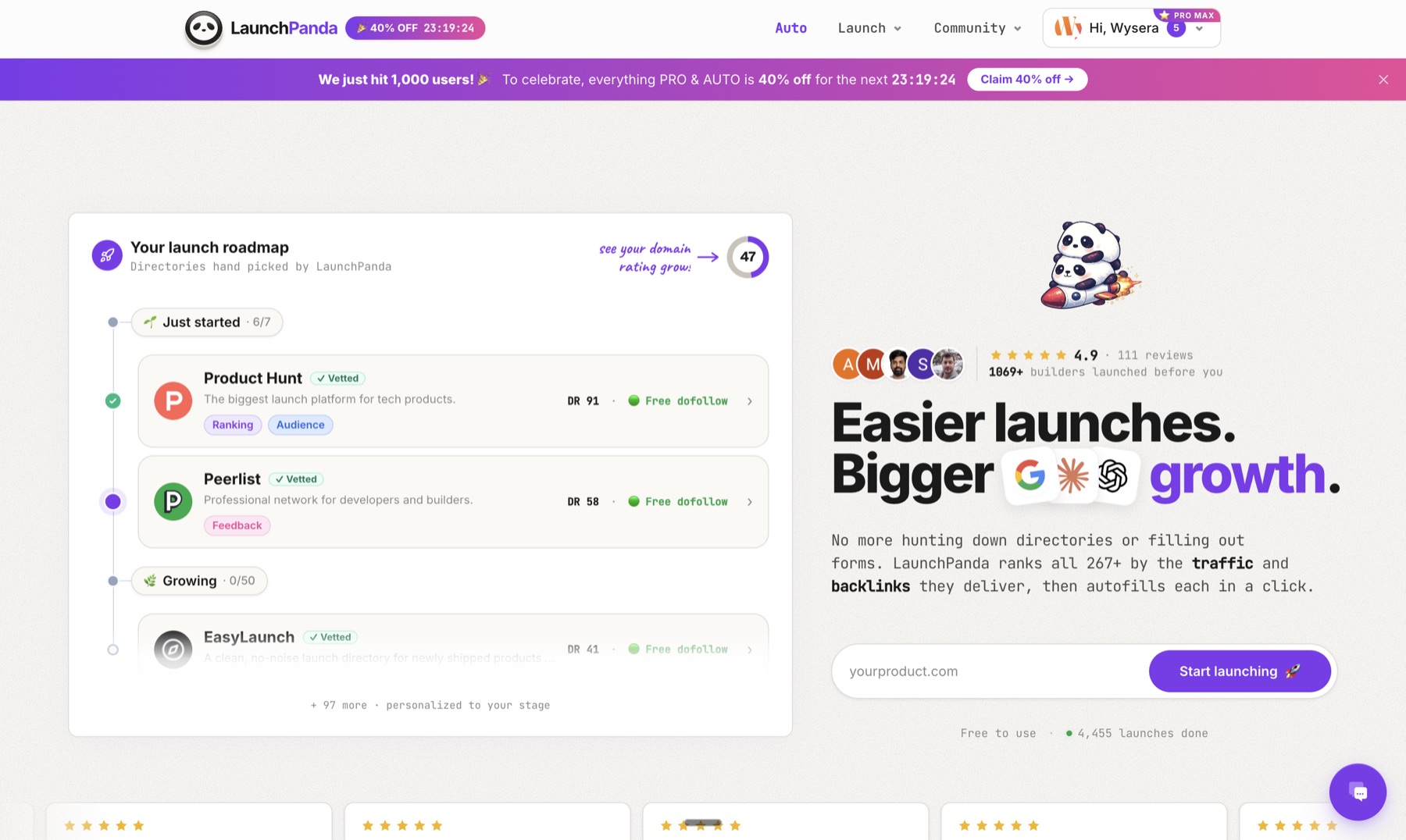
You do not need to hit hundreds. Knowing which ones are worth the afternoon is most of the skill, and the honest shortcut is to sort by the DR of the directory itself and start at the top. A handful of strong listings will move a new domain from roughly 5 to 10 within days, because the base is so small that anything registers. Past that, it is a matter of working down the list.
The list above is LaunchPanda, which ranks 267 or so directories by the traffic and backlinks they actually deliver and then fills in the submission forms for you. It is what we used, and it is where both screenshots in this post come from. The work underneath is the same either way; the ranking is the part worth having, because it is the difference between an afternoon spent on Product Hunt and Peerlist and an afternoon spent on directories nobody reads.
One worth naming, since this section is otherwise a method rather than a list. SaaS City is a SaaS and AI directory that lays its listings out as a city map, where a product’s building grows with votes and views. Submission is free, listings are dofollow, and it clears the bar this section sets: DR 60 with a TrueDR of 67 and traffic-validated visits of roughly 24,900 a month when we checked on 6 September 2026. The number worth noticing is TrueDR sitting above DR, because that is authority earned rather than traded between directories, which is the failure mode described further down. The caveat, stated plainly: it markets itself partly on the backlink, and it sells paid placement alongside the free tier. Neither is disqualifying on a domain with real traffic, but both are the things to check before you decide a directory is worth the afternoon. Disclosure: we and SaaS City link to each other.

What it did for us#
We did exactly this for Wysera, so rather than describe it in the abstract, here is the actual line.
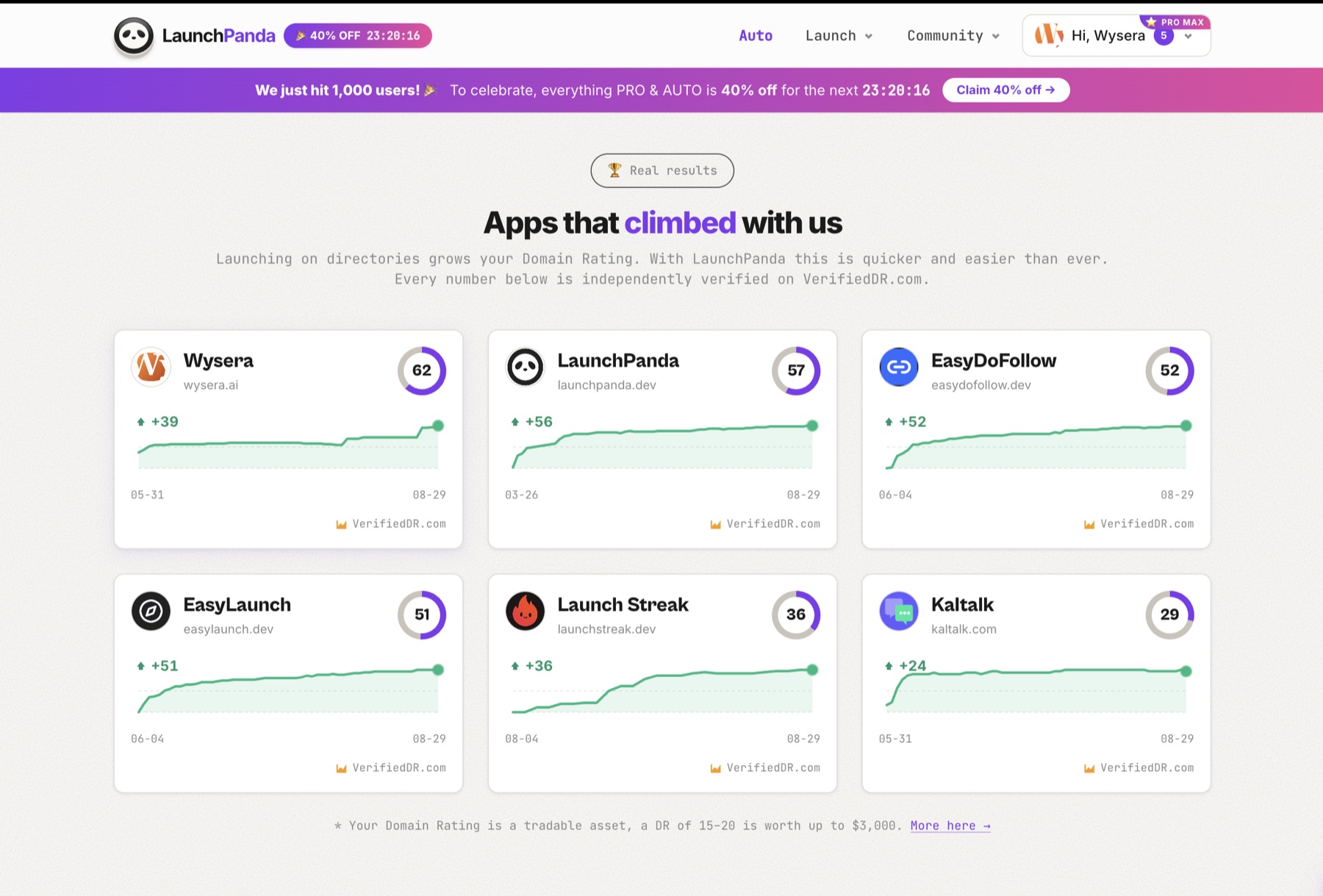
Two things in that chart are worth more than the headline number. The first is the shape: it rises fastest at the start and then steps up in jumps rather than climbing smoothly, which is what the logarithmic scale looks like in practice. The second is that we are not the outlier. Five other products on the same chart show the same curve, which is the useful part, because one company's result is an anecdote and six is a pattern.
What not to do#
The obvious shortcut is to buy links, or to blast submissions at every directory that will take them. It does not work, and it is worth being clear why rather than just disapproving. Directories that exist only to sell listings have no audience, so there is no traffic. Google has been discounting that kind of link for well over a decade, so there is little ranking benefit. And a backlink profile made mostly of those links is a pattern that is easy to spot, which is the thing you do not want to be.
The version that works is slower and duller: launch properly on directories that have real users, publish things worth linking to, and let the two compound. There is no trick underneath it.
DR is one lever on the larger problem, which is that being findable is now harder than building. If you want the wider version of that argument, we wrote about the three surfaces distribution actually runs on, and about how AI answers change what being found means.
Frequently asked
What is Domain Rating?
Domain Rating (DR) is a score from 0 to 100, created by Ahrefs, that measures how strong a website's backlink profile is. A brand new domain starts at 0 and Product Hunt sits at 91. You raise it by getting other sites to link to you, and the links work like votes: one link from a strong site is worth far more than several from weak ones. The scale is logarithmic, so 0 to 20 takes weeks and 40 to 60 takes months.
What is a good Domain Rating for a startup?
For a domain under a year old, anything above 20 puts you ahead of most of your peers, and 30 to 40 is a strong position. Below 10 means almost nobody links to you yet, which is normal at the start and fixable in weeks. The number only matters relative to whoever else is trying to rank for your keywords, so check two or three competitors before deciding whether yours is a problem.
How long does it take to increase Domain Rating?
The bottom of the scale moves fast. Launching on a handful of established startup directories can take a new domain from roughly 5 to 10 within days, because the links are indexed quickly and the starting base is so small. Getting past 30 takes months of consistent linking, and past 50 is a year or more of work. Wysera went from DR 23 to DR 62 in three months, and the slope flattened noticeably as it climbed.
Do startup directories actually help SEO?
The established ones do, for two separate reasons. They send real referral traffic, because sites like Product Hunt and Peerlist have audiences of their own. And they are credible indexed domains, so a listing is a signal that a real company exists at your URL. What does not work is bulk submission to hundreds of empty directories that exist only to sell links; Google discounts those, and at worst they are a liability.
Does Domain Rating affect Google rankings directly?
No. DR is Ahrefs' metric, not Google's, and Google does not read it. It is a proxy: it measures backlink strength, and backlink strength is something Google does care about. So a rising DR usually means the thing that helps you rank is improving, which is why it is worth tracking even though the number itself has no direct effect.